


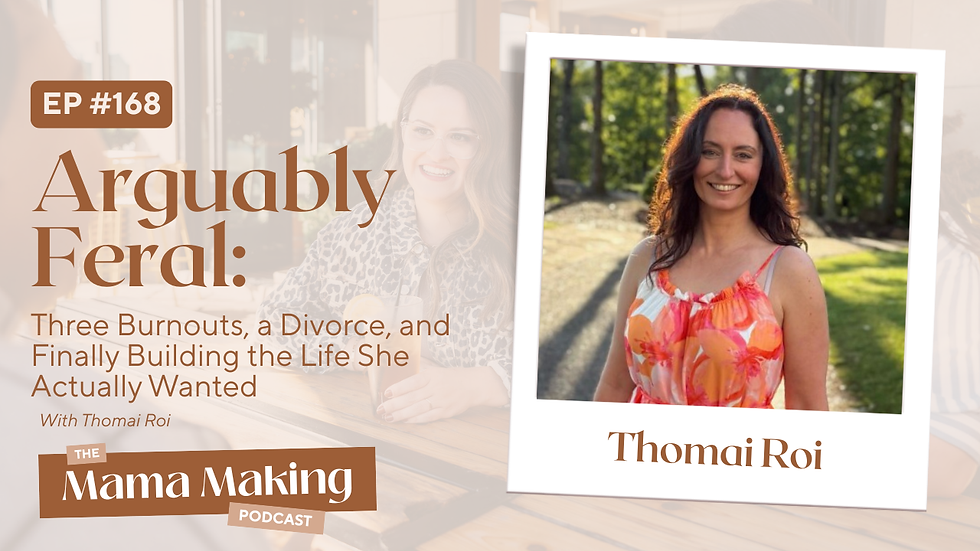
Thomai Roi | Arguably Feral: Three Burnouts, a Divorce, and Finally Building the Life She Actually Wanted


The Life That Looked Right on Paper
There is a particular kind of exhaustion that comes not from doing too much — but from doing things that were never really yours.
The career you chose at 18. The marriage that made sense on paper. The version of motherhood that looked like everyone else's and felt like no one's. The slow, relentless erosion of self that happens when you keep cutting pieces off to make sure everyone else is comfortable.
Thomai Roi knows this exhaustion intimately. And she has spent the last several years of her life — and her career — helping other women find their way out of it.
The Path She Followed Without Questioning
Thomai is a former pharmacist, founder of Arguably Feral Women, and what she calls a divorce doula. She is 41, remarried, and mother to a blended family of three. She has navigated three burnouts, three shuttered businesses, postpartum depression, an inflammatory arthritis diagnosis, and a first marriage that ultimately taught her more about who she was than almost anything else.
She grew up accumulating what she calls identity residue — the invisible layers of expectation, aspiration, and inherited vision that shape the choices we make before we know ourselves well enough to question them. She went to pharmacy school. She got married young — at 24. She became a stay-at-home mom. She became an accidental entrepreneur, writing children's science books as an activity for her and her first child, because she missed intellectual stimulation and the business side of her former career.
And then, over the next decade, she started to notice a quiet but persistent misalignment. The goals she had and the goals of the person she was with were no longer the same. The person she was becoming didn't match the life she had built. And the fear and guilt of doing something about it — the twin forces that keep so many women in place — were immense.
She did it anyway.
What the Body Knows First
Before the divorce, before the reinvention, Thomai's body made its position clear.
In early motherhood she dealt with postpartum depression. She gained significant weight. She felt physically and emotionally unrecognizable. And a few years after her first child was born — and right after her second — she had her first major arthritis flare, discovering for the first time that she had an inflammatory arthritis condition. She was bedridden for two weeks.
She had been ignoring herself for so long — giving away so much of what she had — that her body chose the only language it had left.
She went on antidepressants for a decade. She took anti-inflammatory medication. And after her divorce — not as a prescription, just as what happened — she lost 30 pounds and found she no longer needed either.
She is careful to say this is not advice. It is not a recommendation to get divorced to fix your health, or to stop your medication, or to credit a single decision with a complex outcome. It is simply her own experience. And her experience is that the stress she had been carrying — the chronic, unspoken, accommodated stress of a life that didn't fit — had weight. And when she started to put it down, her body noticed.
Identity Residue
One of the most useful frameworks Thomai offers is the concept of identity residue — the accumulation of who we've been, who we've loved, who we've tried to be safe around, and what we've learned about what life is supposed to look like.
We don't build our early adult lives from a blank slate. We build them from all of that. The vision of what happiness looks like that we inherited from family, culture, media, and religion. The idea that there is a right time for everything — college, career, partner, children — and a quiet shame that follows if you're behind schedule.
She speaks with clear feeling about the absurdity of being asked, at 18, to take on life-altering debt for a degree that locks you into a career path — and then being asked, a few years later, to find the person you'll build your life with before you've had a chance to know yourself. The sunk cost fallacy takes over. You've already invested so much. Changing course feels like failure.
But it isn't. It never was.
The Sunny Day
One of the most honest moments in this conversation is when Thomai talks about the sunny day.
It is a small thing. It is also everything. She describes the weight she carries on beautiful summer days when she has her kids — the internal voice that says: it's sunny, they need to be outside, you need to make this a good day, you need to do the thing, take them somewhere, make the craft, be the mom the day is asking you to be.
She has carried this weight since her first child was young. She still carries it now, as a remarried woman co-parenting across states, running a successful coaching business, and doing the kind of inner work she helps other women do every day.
She is not fixed. She is practicing.
And the practice is this: noticing what you're making the sunny day mean about you. Not as a diagnosis of your failure. Not as evidence of something you need to overcome. But as data. As awareness. As a moment to ask: what is actually needed here, and what am I adding to it from somewhere else?
Sometimes what the kids need is a bike ride and a craft and fresh air. And sometimes what they need is pancakes for dinner and Minecraft on the couch and the feeling of being with a mom who is present — not performing.
That feeling, she says, is what children actually need. The rest is extra. Beautiful, wonderful extra — but not the measure of you.
It's All a Choice
Thomai returns to this idea throughout the conversation, and it deserves to land: it is all a choice.
Not in the toxic positivity sense — not in the way that dismisses structural constraints or implies that every woman has the same options. But in the sense that how you move through your own life, what you accept, what you name, what you decide to change — these are choices. And the woman who has financial independence, she adds, has the most access to those choices. That is not an accident. That is why she speaks so directly about money as a foundation of freedom.
The other side of the choice framework is this: there is no wrong. There is only who you are being in the moment. And who you are being in any given moment is almost entirely a product of things you couldn't have predicted or prevented — accumulated identity, inherited expectation, the information you had at the time. To shame that is to shame yourself for being human. The accountability, she says, is not about fault. It's about asking: given where I am, what do I want to create now?
What She's Building
Arguably Feral Women — both her coaching practice and her podcast — exists for the woman who has done everything right and still feels like a stranger in her own life. The woman going through divorce. The woman in her late 30s who looks around and wonders how she got here. The woman who cut so many pieces off herself to keep everything running that she can't remember what she actually wants.
Thomai also runs a free community on School specifically for women going through divorce — because, she says, it was the loneliest, most terrifying time of her life and she never wants anyone to feel that alone in it. She does weekly live calls with the group. It costs nothing to join.
You can find her on Threads at @thomaeroy and on Instagram at @thomaeroyofficial.
The Takeaway
You are not wrong for being where you are. You are not behind. You are not too far down a path to turn around.
You are exactly who you have been, making exactly the choices that made sense with what you knew. And the moment you start to know something different — about yourself, about what you want, about what isn't working — you get to choose again.
That's it. That's the whole thing.
HOW TO CONNECT WITH THOMAI ROI
Website: www.thomairoi.com
Podcast: Arguably Feral Women
Instagram: @thomairoiofficial
TikTik: https://tiktok.com/thomai.roi
LinkedIn: https://www.linkedin.com/in/thomairoi/
Facebook: https://www.facebook.com/thomairoi
Threads: https://www.threads.com/@thomairoi


Comments