


Beth Mazza & Victoria Sivrais | Entrepreneur Like a Mother: Nine Kids, Two Exits, and the Roadmap They Wish They'd Had


You Don't Have to Choose
Beth Mazza and Victoria Sivrais have heard every version of the argument.
You can't build a real business when your kids are small. You can't be fully present as a mother when you're running a company. Entrepreneurship is too risky when you have a family depending on you. Wait until the kids are older. Wait until the timing is better. Wait until you're sure.
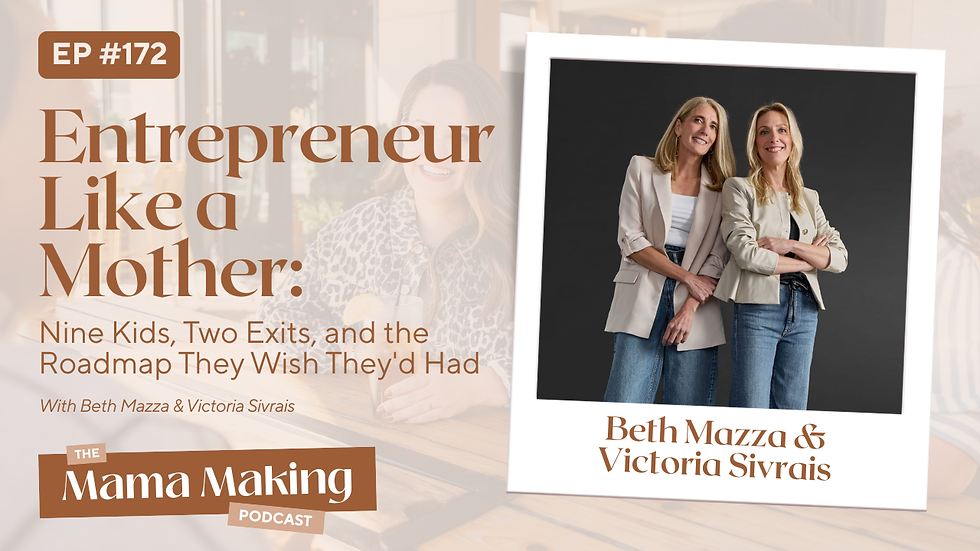
They didn't wait. And together they built two services businesses, scaled them to $50+ million and 55 employees, sold them both to major consulting firms, and raised nine children across all of it — not one born outside their entrepreneurial years.
They are not telling you it was easy. They are telling you it was possible. And they built Female Mavericks — and wrote Entrepreneur Like a Mother — to make it possible for you too.
How It Started
Beth and Victoria have known each other for nearly 20 years. Victoria joined Beth's first company, Ashton Partners, right as Beth was about to give birth to twins. Victoria was 25, ambitious, and privately assumed she'd eventually become a stay-at-home mom. She stayed because she recognized immediately that Beth was the smartest person in the room — and she was ambitious enough to stay close to that.
That first company grew into Claremont, their second services firm, which they launched together in January 2015. Victoria got the call that she was pregnant with twins in February. She got their deposition from the consulting firm they'd left on the Friday before she gave birth on Monday.
They had five kids between them under the age of five when Claremont launched. By the time they sold it, they had nine.
The Green Flags
Neither of them describes the initial leap as confident. Beth calls it plugging your nose and plunging. You do the research, you identify the market, you build the plan — and then you close your eyes.
The green flags came quickly. Clients followed. A new segment got traction. And Beth had a Tuesday where her son Sam was sick and she made the call to work from home and be with him — and no one was going to tell her she couldn't. That moment of control over a Tuesday, she says, was one of the most powerful things she had ever felt.
Victoria's green flag was different: she was done working her ass off to line someone else's pockets. In corporate America, flexibility had become increasingly theoretical the higher she climbed. The real flexibility — the kind that actually exists, not the kind that's promised — was only available if she owned the thing herself.
The Corporate Safety Myth
One of the most important things Beth and Victoria say in this conversation is something most people haven't fully reckoned with: corporate America is not as safe as we tell ourselves it is.
Companies lay people off. They get acquired. They restructure for PE firms. They adopt AI and reduce headcount. The safety of a salary and a benefits package is real in the short term and increasingly fictional over a career. Every year, somewhere between 10 and 20% of corporate employees lose their jobs for reasons they did not choose and cannot control.
The question, they argue, is not whether entrepreneurship is risky. It's whether you're accurately calculating the risk on both sides of the equation. Because sitting on the sidelines waiting for the perfect moment is also a risk — the risk of a chapter never started, a business never built, a version of yourself never given the chance to exist.
Starting When Your Kids Are Young
One of the questions they get most often: isn't it better to wait until the kids are older?
Beth's answer, from the other side of it: not necessarily. Starting when her kids were young meant that by the time they were teenagers — the years that actually demand the most emotional presence from a parent — her business was established, her flexibility was real, and she had built the life she needed to show up for them.
Starting a business when your kids are in high school, she says, is harder. The emotional demands at home are more complex. The crises are less predictable. The windows of opportunity are less consistent.
Victoria adds: her youngest children genuinely don't remember how much she was traveling during the growth years. They were too young. Her older ones remember it — but they also see what the other side looks like. They see a mom who is present, flexible, and building something she loves. And that lesson, she believes, is its own inheritance.
There is also a third option she describes: a woman she mentors who is intentionally not scaling right now. She is building brand and reputation with young kids at home, and her plan is to scale hard when they hit high school. That's her version of the formula — and Beth and Victoria fully respect it.
The point is not that one timeline is right. It's that there is a formula, and you get to build yours.
The Kitchen Cabinet
Beth and Victoria are direct about something they believe was central to their success: they had each other, and they had a kitchen cabinet of women who would not let them fail.
The kitchen cabinet, as they describe it, has three types of people: the cheerleader, the person who fills your blind spots, and the person who grounds you in facts when you are spinning out. You don't need one person to do all three. You need a small circle where all three are covered.
Beth admits to imposter syndrome. Victoria says she doesn't have it — she just goes. And that asymmetry, rather than being a problem, was a superpower. When Beth spiraled, Victoria pulled her back. When Victoria needed numbers to ground her confidence, Beth ran the analysis. They were never in the hole at the same time.
Not everyone has a Victoria. That's why they built Female Mavericks — to be, as Victoria puts it, the virtual work wife that they were lucky enough to have in each other.
The Freedom Number
Before you leap, you need to know your freedom number.
Victoria walks through the calculation in their course and their book: what does your income need to be to keep your family's life running at the level you want? What are the costs to start the business? What are the costs to run it? Can your existing savings, a partner's salary, or side income cover the gap while you build?
If the numbers work — even barely — you have a path. If they don't yet, the question becomes: can you scale back? Start on the side? Find grants or outside funding? Build toward the number instead of waiting for perfect conditions?
The exercise grounds anxiety in data. It takes the overwhelming what-if and turns it into a spreadsheet. And a spreadsheet, Victoria says, is something she can work with.
Entrepreneur Like a Mother
The book exists because nothing like it existed when they needed it.
The entrepreneurship books were written by men whose startup story involved basement apartments and ramen noodles — or by women who focused almost entirely on mindset, with little practical application. Beth and Victoria needed a how-to guide. A roadmap with worksheets. Something that went from ideation to scale with the specific context of someone who also had to make carpool.
So they wrote it.
Entrepreneur Like a Mother covers the full arc: how to identify your market, build your business model, find your freedom number, price your services, build the team that will make your growth sustainable, and scale without burning yourself or your family down in the process. It also includes their real stories — the funny ones, the painful ones, the ones where they made the wrong call and the ones where they barely made it out. It includes worksheets. It includes examples. It is the guide they needed and couldn't find.
It releases September 22nd and is available for pre-order now at femalemavericks.com.
Mom Forward
The last thing they want to leave you with is this: don't hide it.
Beth and Victoria walked into boardrooms and told kid stories. They were mom forward in rooms that were not designed for that energy. They didn't care. They made the choice early that if you were the kind of client who would go blank when they mentioned their children, you were the wrong client for them.
That choice — that refusal to edit themselves — shaped everything. The clients they kept. The culture they built. The community they're growing.
Female Mavericks is that culture, made accessible. A space where you are allowed to be ambitious and also allowed to want to make it home for the thing that matters. Where neither identity is in competition with the other.
Where you don't have to choose.
HOW TO CONNECT WITH BETH & VICTORIA
Website: https://femalemavericks.com/
Instagram: https://www.instagram.com/femalemavericks/
Newsletter: Founders Files https://femalemavericks.com/founder-files/
Entrepreneur Like a Mother — pre-order available at femalemavericks.com, launches September 22nd https://femalemavericks.com/entrepreneur-like-a-mother/


Comments