


Mariela De Santiago | The Second Baby Playbook: Postpartum Recovery, Sibling Prep, and Everything We Wish We Knew
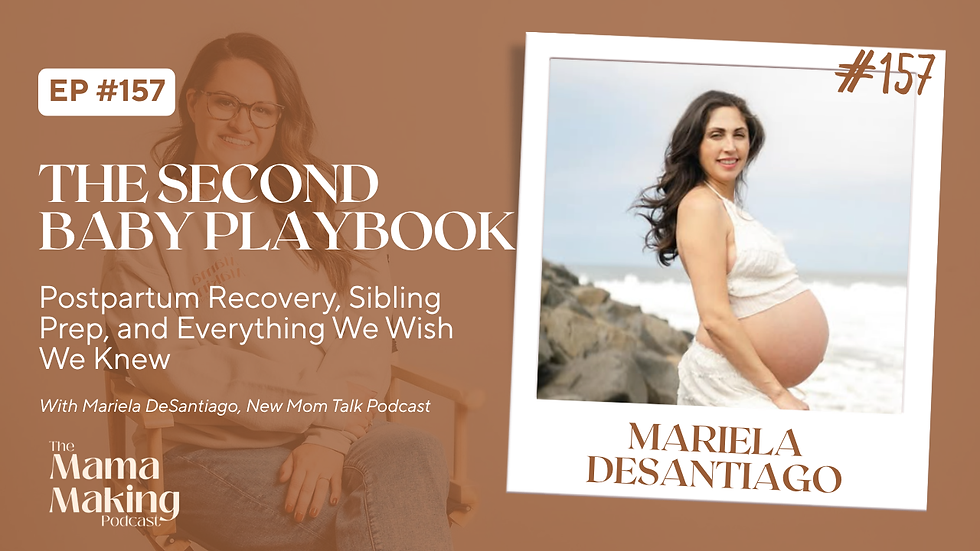

The Second Baby Playbook: Postpartum Recovery, Sibling Prep, and Everything We Wish We Knew
Nobody tells you the second pregnancy might be harder.
You've done this before. You know what's coming. You have the stuff, the experience, the battle-tested knowledge of a mom who has already survived the newborn stage once. And then the morning sickness hits, or the iron deficiency, or the bone-deep exhaustion that somehow feels worse than the first time — and you realize that having done it before doesn't mean you know exactly what you're in for.
That's where Mariela De Santiago found herself the second time around. And in this conversation, she and Jessica get into all of it — the harder pregnancy, the planned C-section she chose for herself, the postpartum non-negotiables she put in place, and the things she wishes she had known the first time.
If you're expecting your second baby — or even just starting to think about it — this one is for you.
When the Second Pregnancy Is the Harder One
Mariela's first pregnancy was smooth. No morning sickness. She worked and ran up until she delivered. Easy, by her own account.
Baby number two? Completely different.
The morning sickness was real. Working out — her primary form of self-care and her main emotional outlet — was no longer possible. She was iron deficient. Climbing a flight of stairs required two breaks. And the emotional toll of having her body feel suddenly out of her control, combined with the loss of the one thing that had always helped her cope, was genuinely hard.
What she did differently this time was give herself permission to slow down. Chiropractic care, monthly massages, acupuncture — things she hadn't done with her first pregnancy — became non-negotiables. Her son went into full-time school during her third trimester so she could actually rest. And instead of pushing through, she sat with it.
That decision — to stop performing fine and actually care for herself — is something both Mariela and Jessica kept returning to throughout this conversation. Because so often in motherhood, we white-knuckle through the hard parts instead of asking for what we need.
Preparing Your First Child for Baby Number Two
One of the most anxious parts of expecting a second baby is watching your first and wondering — how is this going to change things for them?
Mariela comes from a special education background, and that shaped how she approached the transition: slowly, deliberately, one change at a time. The bedroom transition happened first, well before the baby arrived. Then the school schedule shifted. Books about being a big brother came next. And throughout all of it, her son was given ownership — invited to help pick out onesies, involved in setting up the nursery, celebrated as a big boy at every turn.
The result? He became one of the most enthusiastic big brothers from day one. Helping with diapers, involved in everything, not showing the displacement Mariela had feared at all.
Both Mariela and Jessica talked about the fear that a first child will feel replaced — and how much of that fear, honestly, we as mothers put on ourselves more than our children experience it. What helps most, they agreed, is simply involvement. When children feel like part of what's happening rather than something happening to them, everything goes more smoothly.
Choosing Her Birth — And Why a Planned C-Section Felt Like Control
Mariela's first birth was an induction that became an emergency C-section — unexpected, out of her hands, and followed by a tough recovery. So when it came time for her second, she made a deliberate choice: she opted for a planned C-section.
Not because it was the easier path — but because it was the one she could plan around. She knew what the recovery would look like. She could arrange childcare in advance. She could drop her son off with family, spend the morning with her husband at the beach, shower, and arrive at the hospital calm and ready.
The contrast between the two births couldn't have been more different. One was chaos. The other was — as much as birth can be — on her terms.
There's something powerful in that. The idea that choosing your birth experience, whatever that looks like, is an act of self-advocacy. That knowing what to expect and planning accordingly isn't giving up — it's taking care of yourself and your family.
The Postpartum Non-Negotiables
This is where the conversation gets incredibly practical — and incredibly useful.
Mariela's top five things she did differently for postpartum recovery with her second:
A postpartum doula. Her highest recommendation, and Jessica's too. A postpartum doula isn't just for the baby — she's for the whole family. Mariela used hers most during the evening witching hour, when her son was home from school, dinner needed to happen, and she was tied up feeding the baby. Having an extra set of hands meant nobody got ignored and nobody went unfed.
A house cleaner who came the day they arrived home from the hospital. Coming home to a clean space after days in a hospital feels like exhaling. Especially with a toddler who had been home all week bringing school germs and general chaos.
A hairstylist who came to her. Postpartum hair loss was real, and Mariela wanted a fresh cut — but not badly enough to leave the house, arrange childcare, and show up anywhere on a schedule. So she had her stylist come to her. In her pajamas. While the baby napped. Highly recommend.
Meal delivery that worked for their lifestyle. As a plant-based family, a traditional meal train wasn't realistic. Instead they used Purple Carrot — a plant-based meal kit delivered to their door, prepped by their postpartum doula. The food was on their terms, nobody had to stress about dietary restrictions, and dinner was handled.
Newborn photos at home. Mariela didn't do the wrapped-up newborn photos with her son and still wishes she had. This time, a photographer came to their house about a week and a half after her daughter was born. Tiny baby, home setting, no leaving required.
The Postpartum Cart — and the Mini Fridge Hack
If you haven't heard of the postpartum cart, consider this your sign to build one. Mariela set up a rolling cart with everything she could possibly need — nipple butter, manual pump, snacks, diapers, face wipes — and stationed it wherever she'd be spending most of her time.
She also put a mini fridge (one of those small cosmetics or beverage fridges) in their bedroom. So when she pumped in the middle of the night, she could store the milk without ever going downstairs.
Simple. Brilliant. Worth every penny.
Freeze-Drying Breast Milk — the Game Changer Neither of Them Knew About the First Time
This was the moment in the conversation that stopped Jessica cold.
Freeze-dried breast milk. Mariela uses a service called Milk by Mom that takes pumped milk and freeze-dries it — making it shelf stable for up to three years. It travels without refrigeration. It doesn't expire sitting in your freezer. And it doesn't go to waste if your baby doesn't drink it before it goes bad.
Jessica admitted she had thrown out significant amounts of pumped milk the first time around that she never ended up using. This service would have changed that entirely.
If you're pregnant, postpartum, or thinking ahead — look into Milk by Mom. Mariela has a discount code linked in the show notes.
Staying Aligned with Your Partner
Both Mariela and Jessica came back to this throughout the conversation: the couples who do best in that chaotic newborn-plus-toddler season are the ones who talk about everything in advance.
Who's handling drop-off and pick-up? What does the bedtime routine look like when one parent is nursing? Who's coming to the hospital — and when? What do you actually want people to do when they come to visit? (Hint: ask them to move the dishes. People want to help. They just need to be told how.)
Mariela was clear and direct about her visitor preferences the second time — nobody at the hospital, specific boundaries around her home — and it made an enormous difference. Not because family and friends weren't welcome, but because protecting those early days as a family first gave them a foundation to come home to.
Have Your Provider List Ready Before You Need It
One thing Mariela and Jessica had talked about planning during their first episode together: keeping a document of service providers you might need postpartum — lactation consultants, postpartum doulas, therapists, bodyworkers — so that when you need someone in an exhausted, overwhelmed moment, you're not starting from scratch.
Mariela used it. She needed a lactation consultant support group during a stretch when her pumping had gotten inconsistent, and knowing exactly where to go meant she got help quickly instead of spiraling through Google at 2 a.m.
It's a small thing to put together now that pays enormous dividends later.
The Takeaway
The second time around isn't just about having more stuff or more experience. It's about using what you learned — about yourself, your body, your family — to make more intentional choices.
Slow down when you need to. Ask for what you actually need. Protect your space. Get the postpartum doula. Build the cart. Freeze-dry the milk. And let the people who love you help in the ways that actually help.
You've done this before. This time, you get to do it on your terms.
How to Connect with Mariela De Santiago
Instagram: @newmomtalk.podcast
Podcast: New Mom Talk Podcast


Comments